Félicité VINCENT
Une exposition récemment conclue au Kimbell Art Museum de Fort Worth s'est concentrée sur l'art africain du point de vue de ses créateurs. Originaire de l'Art Institute of Chicago, l'exposition présentait des œuvres traditionnelles non pas du point de vue des colonisateurs qui les collectionnaient, mais à travers les normes de beauté, de laideur et de pouvoir adoptées par ceux qui les avaient créées. Le catalogue présente des essais de sept universitaires sur divers aspects de l'esthétique africaine. Il n'a pas d'entrées de catalogue individuelles (ce qui nécessiterait un autre gros livre). La liste de contrôle de l'exposition contient des informations sur la provenance de chaque œuvre, sauf dans de rares cas où elle n'est pas connue.
Je me suis renseigné sur la non-participation de ces cinq musées, et j’ai reçu cette réponse de Costa Petridis, président et conservateur des Arts of Africa, The Art Institute of Chicago, qui a organisé l’exposition : « Je voulais donner la priorité aux collections de musées moins connues avec d’excellentes collections qui sont beaucoup moins visibles et accessibles et plus rarement incluses dans les expositions. » Bien que la qualité des œuvres de l’exposition soit élevée, l’exposition aurait été encore meilleure avec des prêts d’œuvres de choix des musées mentionnés ci-dessus, ainsi que de certains petits musées aux collections stellaires, tels que le Musée Dapper à Paris.
Petridis a jeté son filet large, avec un total de 288 œuvres répertoriées dans le catalogue. De nombreuses pièces proviennent de collections privées. Trente-six collectionneurs privés d’Europe et des États-Unis sont des prêteurs de l’itération Kimbell de The Language of Beauty in African Art (l’exposition sera encore plus grande à Chicago). Deux prêteurs privés viennent du Texas, en plus du Kimbell Museum of Art, de la Menil Collection, du Museum of Fine Arts de Houston et du Dallas Museum of Art (ce dernier possède l’une des cinq meilleures collections d’art africain aux États-Unis). Plusieurs œuvres des collections du Texas sont discutées dans cette revue.
Cette revue se concentre sur deux classes d’objets: les figures reliquaires Kota au début de la revue et les figures de puissance Kongo à la fin. L’impressionnant ensemble de ces derniers est le clou de l’exposition. Entre ces deux groupes, je discute d’un assortiment de sculptures et de la façon dont elles ont été utilisées et considérées par les cultures qui les ont produites.
Figures du reliquaire de Kota
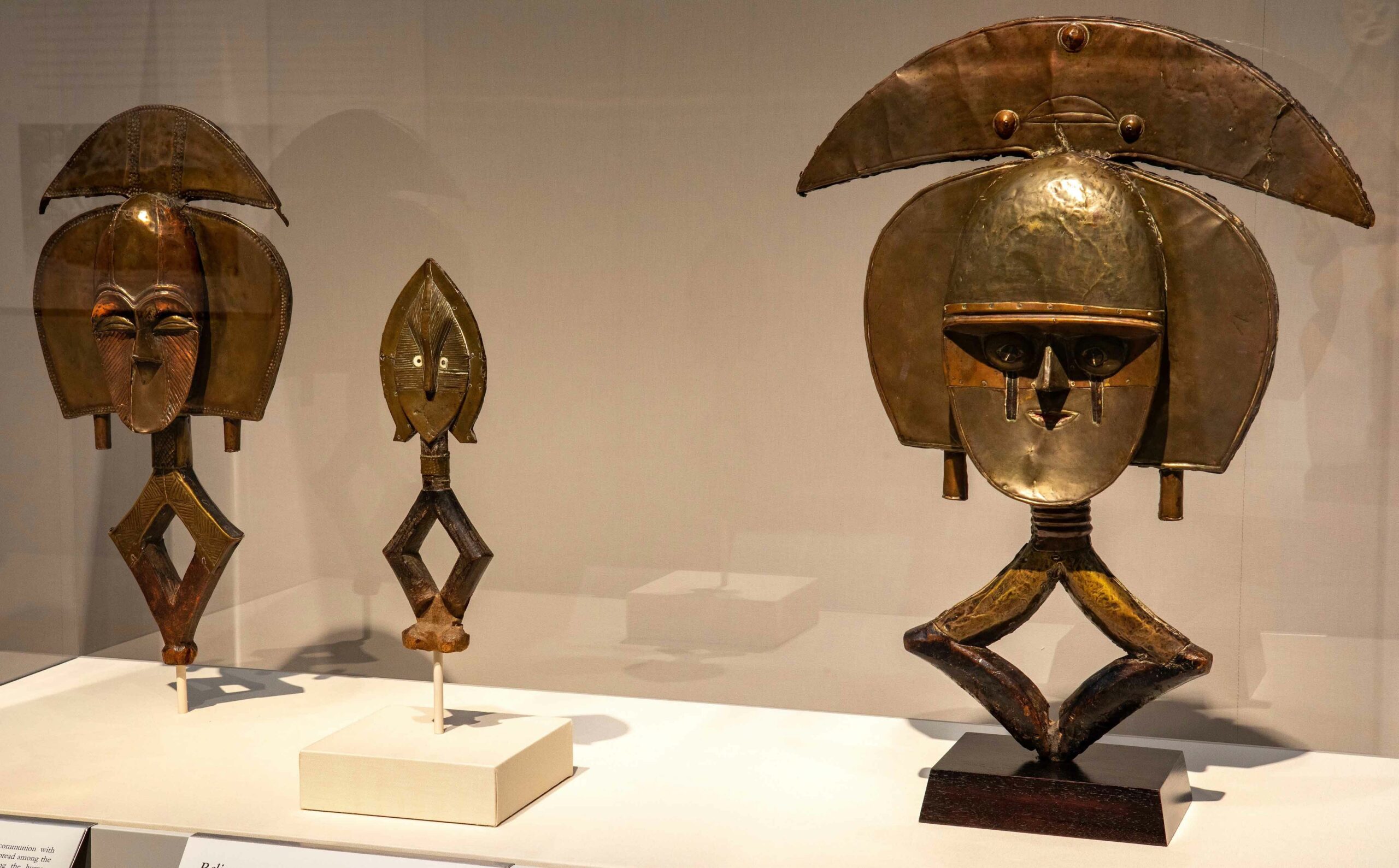
Vue d’installation de « Le langage de la beauté dans l’art africain ». Photo : Robert LaPrelle, Kimbell Art Museum. De gauche à droite : Reliquary Guardian Figure (Mbulu Ngulu), fin du 19e – début du 20e siècle, Kota : Obamba, Gabon, bois, cuivre, laiton et fer, The Art Institute of Chicago, Charles H. and Mary F. Worcester Collection Fund, 2007.212; Reliquary Guardian Figure (Mbulu Ngulu), fin du 19e – début du 20e siècle, Kota: Obamba, Gabon, bois, cuivre, laiton et fer, The Art Institute of Chicago, Charles H. and Mary F. Worcester Collection Fund, 2007.212; Attribué à Semangoy de Zokolunga, Janus Reliquary Guardian Figure (Mbulu Ngulu), fin du 19ème ou début du 20ème siècle, Kota: Obamba; Gabon, laiton, cuivre, fer, bois et fibre, Dallas Museum of Art, The Eugene and Margaret McDermott Art Fund, Inc., 2005.36McD.
Les éléments sculpturaux des ensembles reliquaires Kota de l’actuel Gabon et de la République du Congo ont été parmi les premières sculptures africaines à être emmenées en Europe au XIXe siècle. Pour une illustration des différents types de figures reliquaires Kota et des emplacements géographiques dans lesquels elles ont été réalisées, voir Tribal Art Magazine Special Issue #5: Kota New Light (fromforth TAMK), 2015, p. 29.
Ils ont commencé à arriver dans les années 1870. (Les trois de l’exposition Kimbell sont illustrés ci-dessus; un total de huit sont illustrés dans le catalogue, donc un plus grand nombre sera exposé à Chicago, l’autre lieu de l’exposition.) Les expositions internationales à Paris en 1878, 1889 et 1900 (visant à accroître le soutien à l’expansion impériale en Afrique) présentaient des objets d’Afrique centrale.
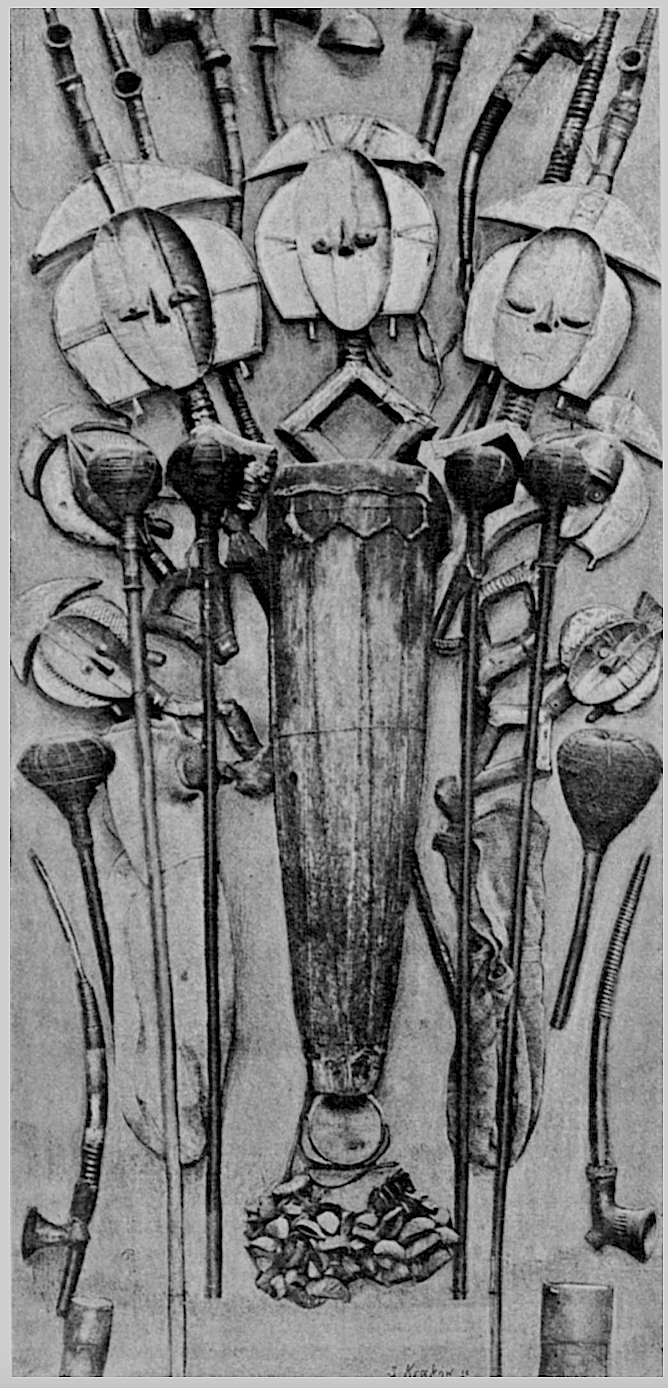
Les figures reliquaires Kota ont également été parmi les premières sculptures africaines à être profondément appréciées, collectionnées et imitées par les artistes européens au début du XXe siècle. Ces sculptures ont toujours été séparées de leur contexte rituel et leurs formes ont été mal interprétées. Dans l’héliogravure ci-dessous, ils font partie d’un éventail de curiosités ou de trophées.
Installation view of Gabonese artifacts collected by Pierre Savorgnan de Brazza and donated to the Musée d’Ethnographie du Trocadéro, Heliogravure published in Le Tour du monde, 1888. The caption read: “Drums, masks, etc., of the Ondoumbos—After an assortment exhibited at the Trocadéro.” Photo: Alisa LaGamma, ed., Eternal Ancestors: The Art of the Central African Reliquary, 2007, Metropolitan Museum of Art.
In the above illustration, the central Kota reliquary figure seems to be dancing on the large drum, presumably accompanied musically — or awakened by — the rattles in the foreground.
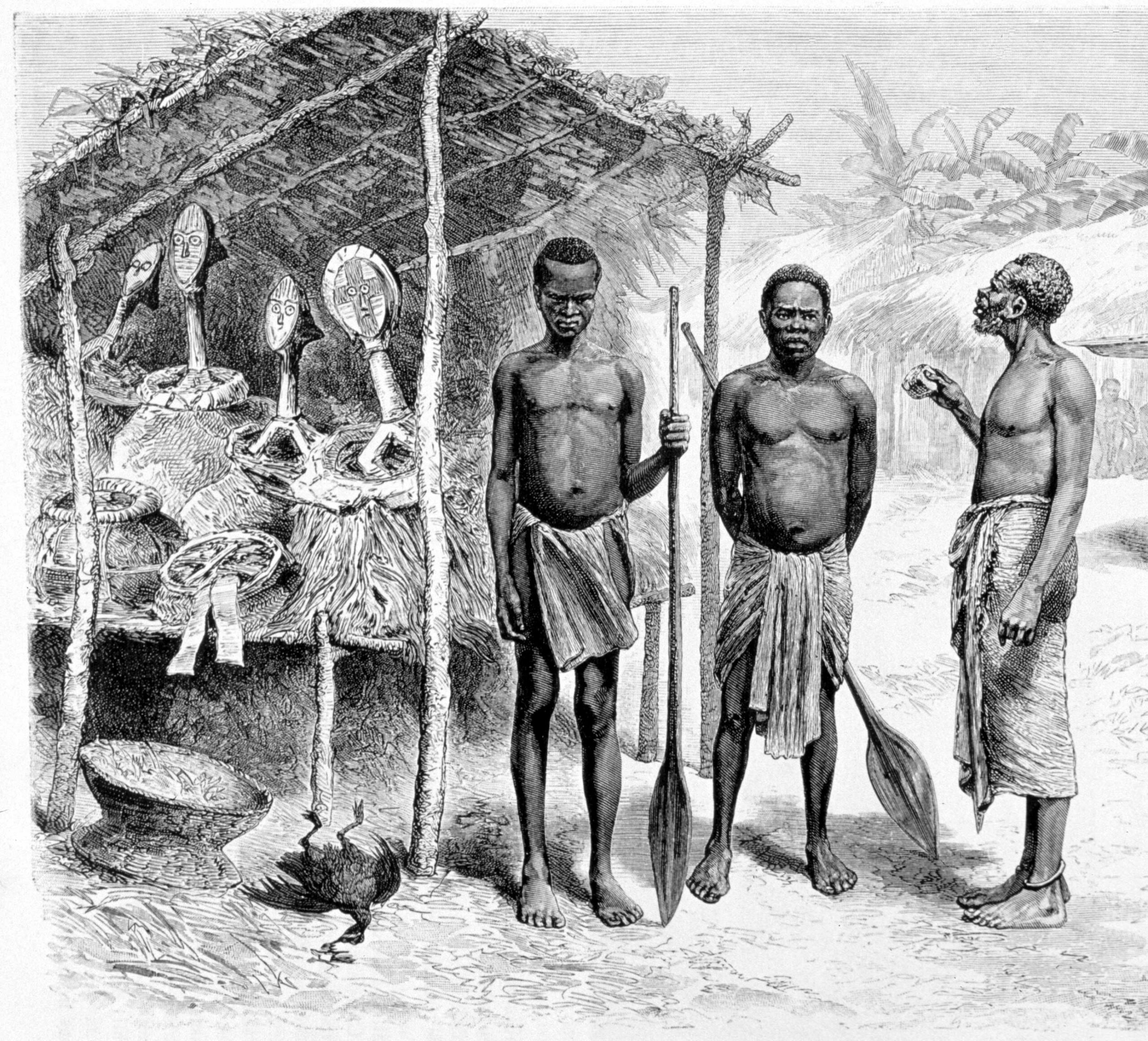
Field engraving by Edouard Riou (cropped on the right), based on a drawing by Jacques de Brazza (brother of Pierre), published in article edited by Pierre Savorgnan de Brazza and Edouard Charton in Le Tour du monde, 1887. Photo: Ross archive of African Images. The original caption read: “Invocation of the fetishes.”
These brass and copper-sheathed wood sculptures were made to protrude from baskets that were woven from plant fibers or fashioned from (or adorned with) strips of hide (in Riou’s print, the rightmost basket is adorned with a full-length fringe of hide). Other, smaller guardian figures also stood atop or inside of cylinders fashioned from bark.
Both types of reliquaries contained the prized bones of notable ancestors. The ancestor cult for which these objects were made is generally referred to as bwiti or bwete. Because the soil was so bad in the regions these objects were made, the groups who lived there had to move every few years. Bones were thought to carry the powers of ancestors. Relic bundles enabled this great power to be made portable.
These sculptures were guardian figures that protected the valuable relics. Four guardian figures can be seen in the left background of Riou’s print. (They are too large in proportion to the men in the foreground, but they convey the context in which these artifacts were maintained.)
One theory holds that these guardian figures served as idealized ancestors, perhaps founders of lineages. In an important article in TAMK entitled “New Light on the Kota,” Frederic Cloth argues that reliquary guardian figures represent individual local spirits, each of which “plunges its ‘arms’ into the basket of ancestral relics in a gesture that can easily be interpreted as a protective one.”
In any case, these reliquaries — in conjunction with the sacred bundles they inhabited — were ritually consulted.
The text in the Tour du monde article that featured Riou’s print read in part:
the fetishes will be consulted and leave will be taken. The chief takes the rattle used [to] wake the spirits and seeks guidance from the skulls of his ancestors. Their reply, solicited by the offer of a basket of bananas, is entirely favorable. The young men then cut a few clumps of their hair, a nail from each foot and hand, and bow down before their father. He gravely gathers locks and clippings, gathers them into a packet and places it ceremoniously in the hut of idols.
In Riou’s print, the older man on the right is presumably making an offering of a packet that contains clippings from his sons. The dead fowl in the foreground must have served as a sacrifice — its blood would have been sprinkled on the reliquary figure and relics.
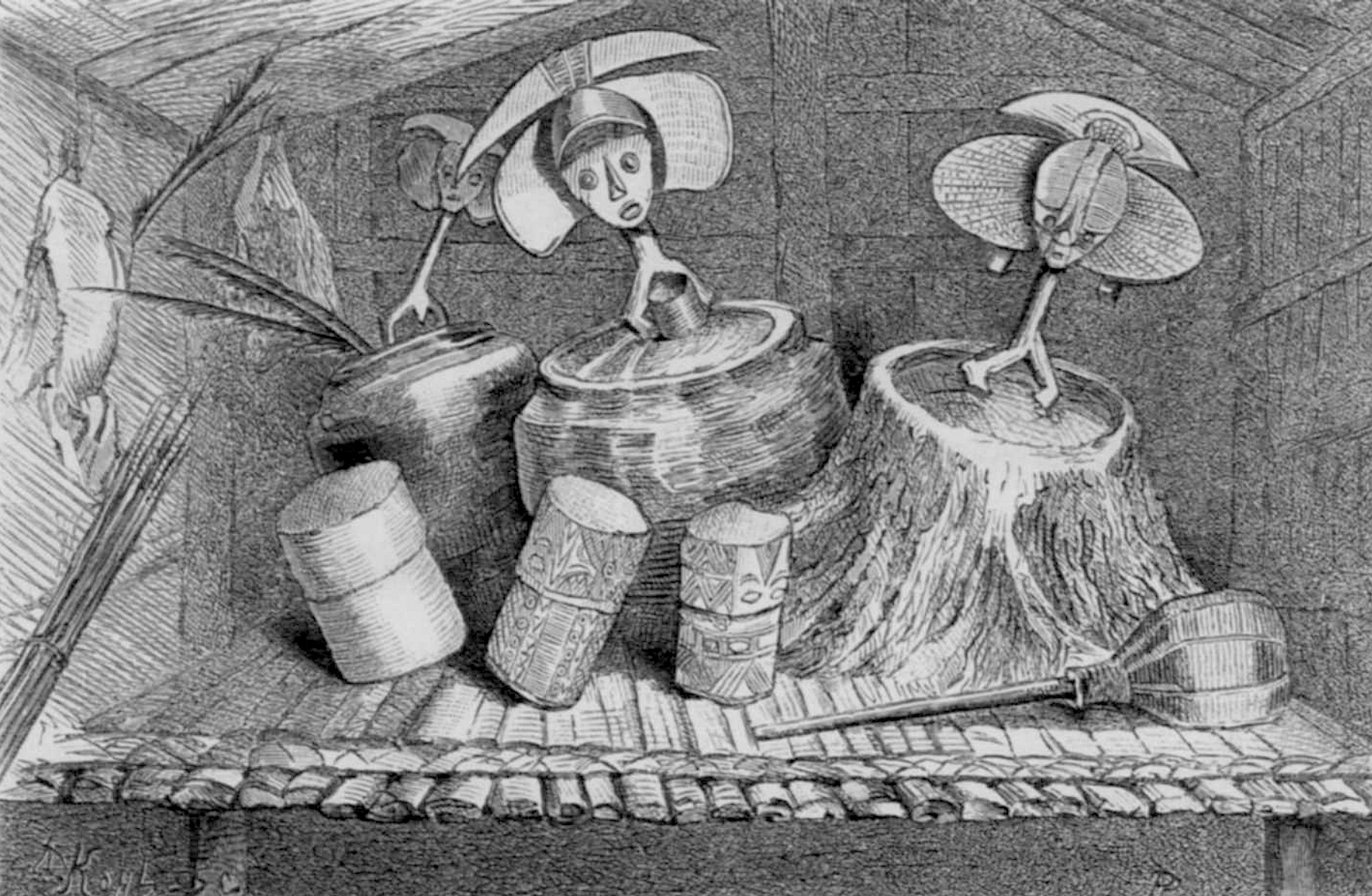
Drawing by Alfred Pâris, titled “Fetishes from Pongo,” published by de Brazza in “Le Tour du monde,” 1888. Photo: Eternal Ancestors catalog, 2007.
Another drawing in a Le Tour du monde article shows three Kota reliquaries in baskets on a table within a sanctuary. Only adult males who had been initiated into the cult could view these artifacts. The cylinders in the foreground are smaller reliquaries made of tree bark (photographs illustrating reliquaries of this type are discussed below in connection with Kota and Fang reliquary guardians). The rattle in the left foreground is presumably the one utilized to “awaken the spirits.”
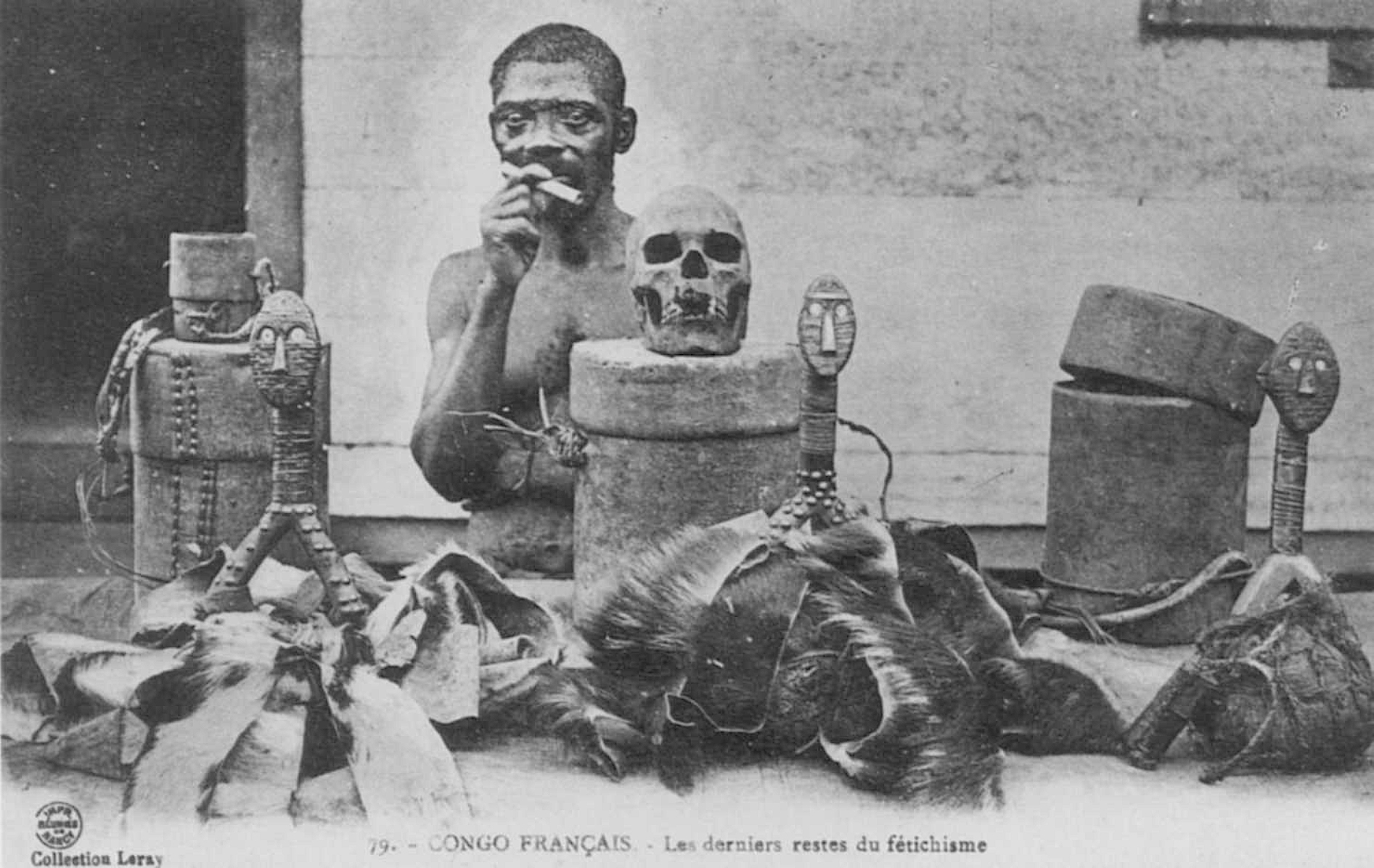
Postcard with photograph attributed to Monsignor Augouard of a Sangu nganga (healer), early 20th century, postcard 3 7/16 x 5 ½ inches, Holly W. Ross Postcard Collection. The caption reads: “Les derniers restes du fétishisme” (The last vestiges of fetishism). Photograph: Eternal Ancestors catalog, 2007.
This photograph (with a white shirt painted on the healer) was utilized in a 1912 book that featured the following text: “Below this box, they often set a rough and hideous statue, sculpted by great ax blows on a uniform trunk of black wood. This, in truth, is Biéri, the national god, the universally dreaded fetish of the non-initiated, the statue, representation of the invisible god of evil, he who must be appeased from time to time, especially during periods when the moon is full, by offering victims for sacrifice in a remote corner of the dark forest.” See Ross Archive of African Images for the photograph with the painted shirt.
In the above postcard image, a healer poses with three Kota reliquary ensembles (the two on the left feature large, wide strips of hide; a large basket is visible in the middle example; the basket on the right does not have a hide fringe). The leftmost bundle seems to have been undone (the basket, if present, must be small). Behind the three reliquary figures, one can see three large cylindrical reliquaries made of bark (and an additional small one on the left). The skull in the center of the photograph could have come from the undone bundle on the left, or from the open box on the right.
Smoking was an important part of ritual divination and healing, and, as we have seen, rattles were utilized to activate the spirit of the reliquary. So the combination of reliquary figures, rattles, and pipes in the Trocadéro Heliogravure reproduced near the top of this review is perhaps not as random as might be assumed.
A photograph by Dr. Stephen Chauvet, c. 1930 (from the book La médecine chez les peuples primitifs, Paris, 1939; reproduced in TAMK, p. 15), shows one man holding a Kota reliquary while another man removes relics from a basket (which features a hide fringe at the top). These relics include four complete skulls (two of which have holes in the top that could have served as a base for the reliquary guardian figure).
The reliquary figures, as well as the relics themselves, could be removed from the relic bundles for ceremonies and rituals.
For the Kota, skulls were the most important ancestral relics, a fact that is reflected in the forms of the guardian figures themselves. They are essentially large heads with stylized armatures that serve to project the heads out of the reliquary bundles. These lozenge-like armatures are not abstracted depictions of the entire body, as twentieth-century artists and collectors tended to assume. They instead represent shoulders and arms. Half-figures carved out of wood also feature depictions of figures with arms in a lozenge shape. See Cloth’s drawing that relates a Kota reliquary to six wood sculpture types (TAMK, p. 30). For photographs of two wood sculptures from DR Congo or Gabon that relate to Kota reliquary guardian figures, see TAMK, p. 66.
As we have seen, the reliquary statues are not simply guardians of the relics. As a part of reliquary ensembles, they played an important part in rituals, especially those that involved ancestry. As Joshua I. Cohen notes in the discussion of a Kota reliquary figure on the Metropolitan Museum of Art’s website, these ensembles offered many kinds of assistance:
Such rites and performances are known for remedying social crises and for ensuring success in matters ranging from fertility and health to hunting and trading. Reliquary ensembles also played an essential role in initiation rituals that pertained to the transfer of family history and genealogy. Typically housed in the residence of a family or clan leader, reliquary ensembles broadly offered assistance and protection in shielding their communities from harm, following a belief in the responsiveness of venerated ancestors to appeals from their descendants invoked through sacrifices, medicines, and prayers.
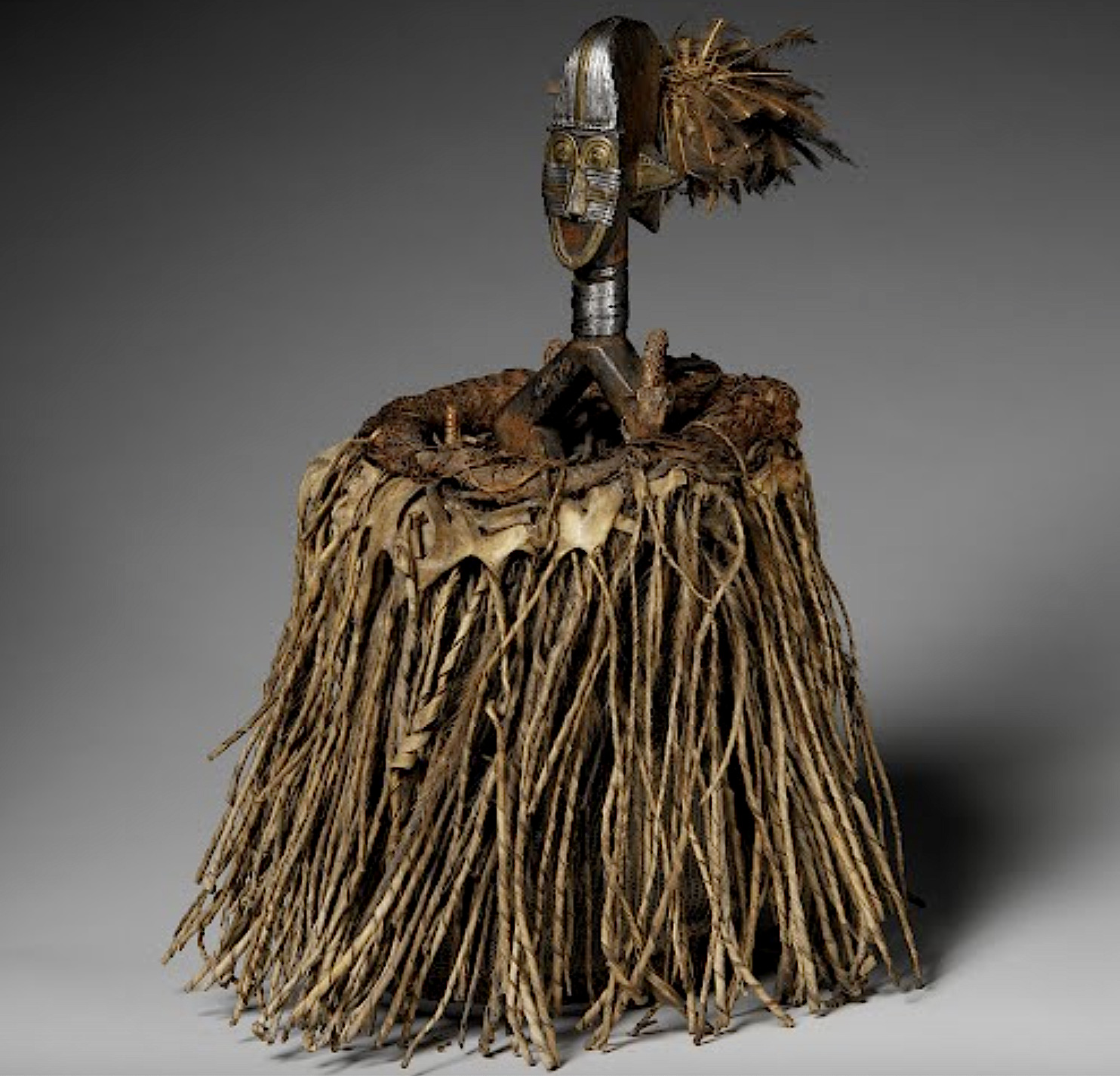
Reliquary Guardian and Bundle, Kota: Obamba, Gabon, before 1897, wood, copper, brass, iron, plant fibers, rattan, animal hide, human bones, feathers, 600 cm high, Musée du Quai de Branly, France. Photograph: Google Arts & Culture. Not in the exhibition.
Over 2000 Kota reliquary figures have survived, but very few have been preserved inside their relic bundles. The example illustrated above features a complete basket that has an encircling leather fringe like one of the examples in the Riou print illustrated above. It provides a sense of what these objects looked like in their cultural context.
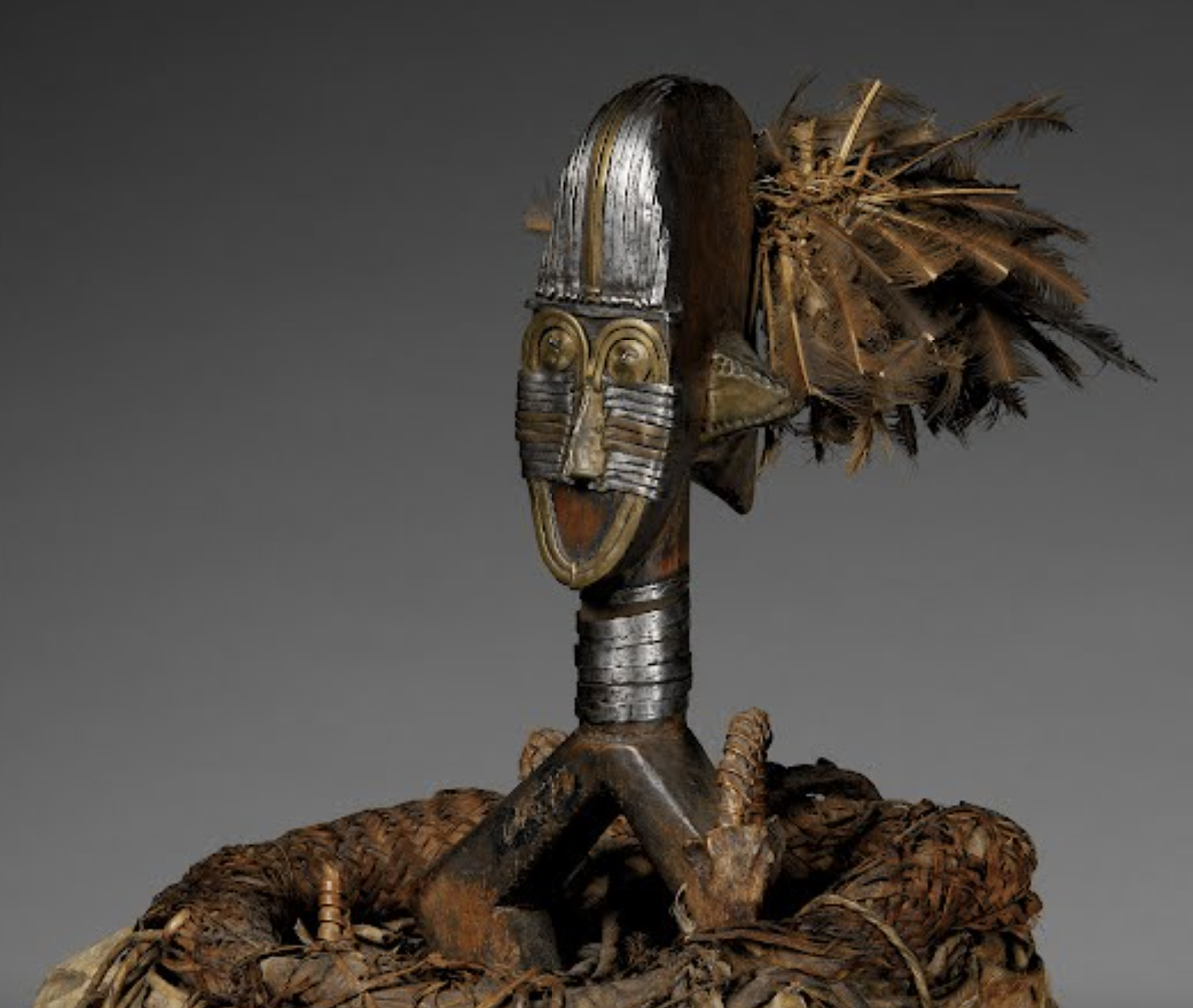
Reliquary Guardian and Bundle, Kota: Obamba, Gabon, before 1897 (detail). Photograph: Google Arts & Culture. Not in the exhibition.
This reliquary figure also has a feather adornment. Large amounts of iron are utilized in the head and neck, making a sharp contrast with the more golden-hued brass and copper elements.
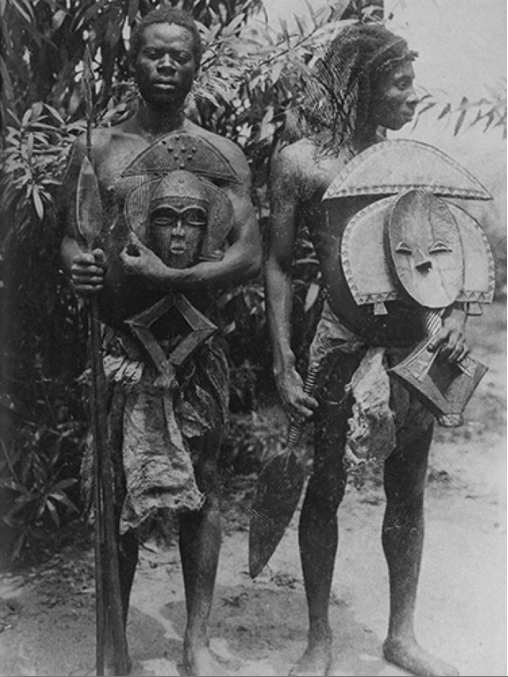
Two men holding reliquary figures and ceremonial weapons, 1917. Photograph by rev. G. A. Jacobsson, Svenska Missionskyrkans Arkiv, Stockholm. Photograph: Sotheby’s. (Compare the large spearheads to the ones in the Riou print.)
Cloth argues that the above photograph, along with another one of the same two men (with different clothes) with two small anvils and a third reliquary figure (illustrated in TAMK, p. 42) show the men in the act of surrendering their prized objects to missionaries as proof of conversion. Two of the guardian figures in these two pictures entered a Swedish missionary museum, from which they passed into the National Museum of Ethnography.
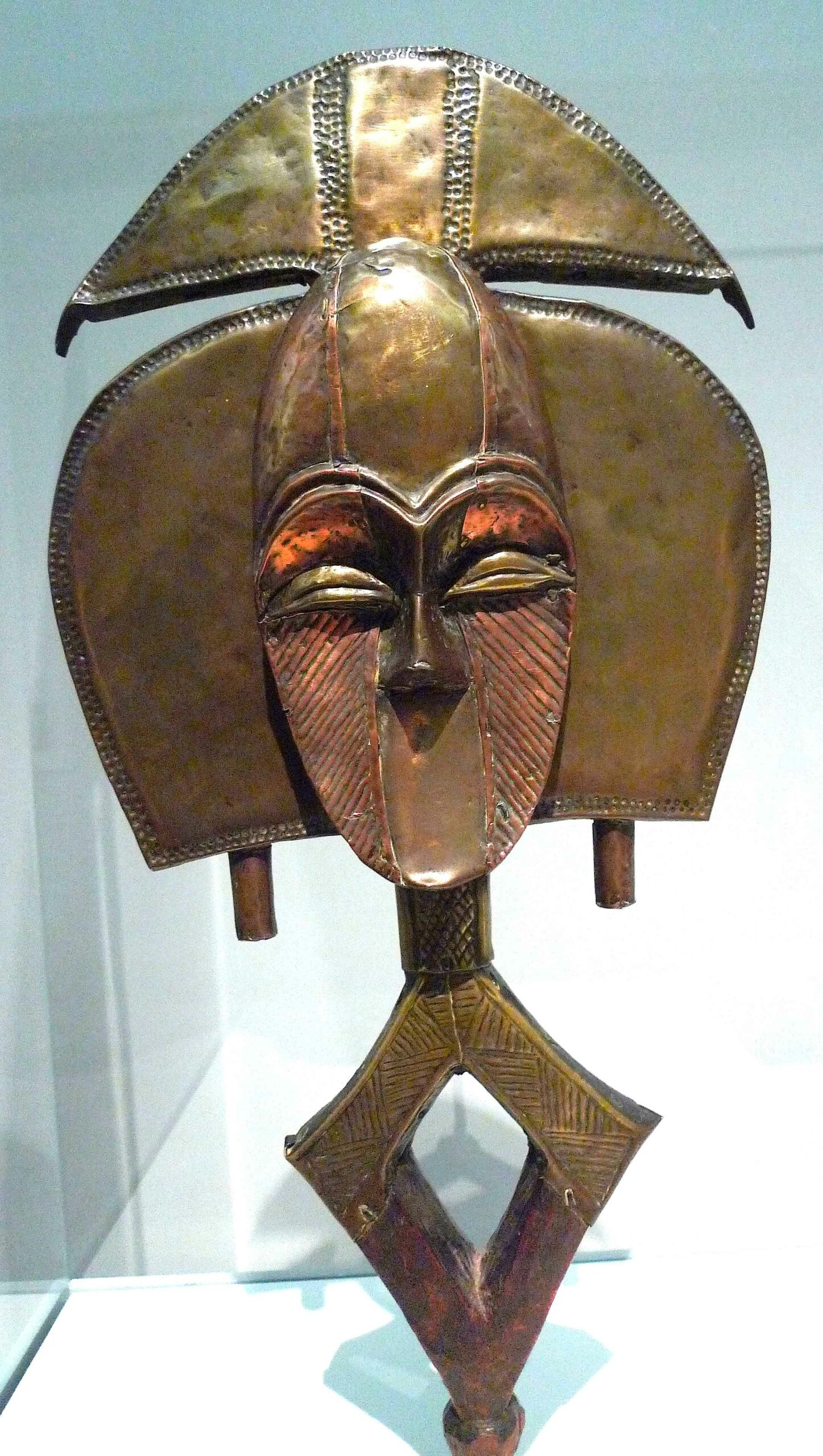
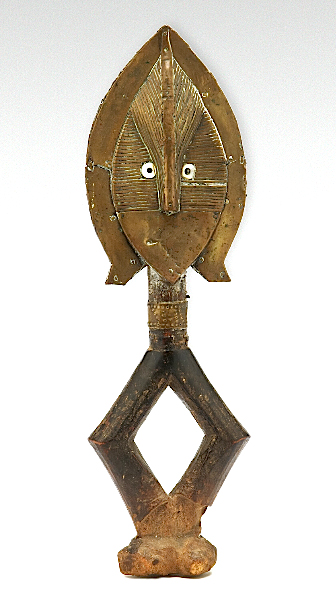
Reliquary Guardian Figure (Mbulu Ngulu) late 19th – early 20th century, Kota: Obamba, Gabon, wood, copper, brass, and iron, The Art Institute of Chicago, Charles H. and Mary F. Worcester Collection Fund, 2007.212. Photograph: Ruben C. Cordova.
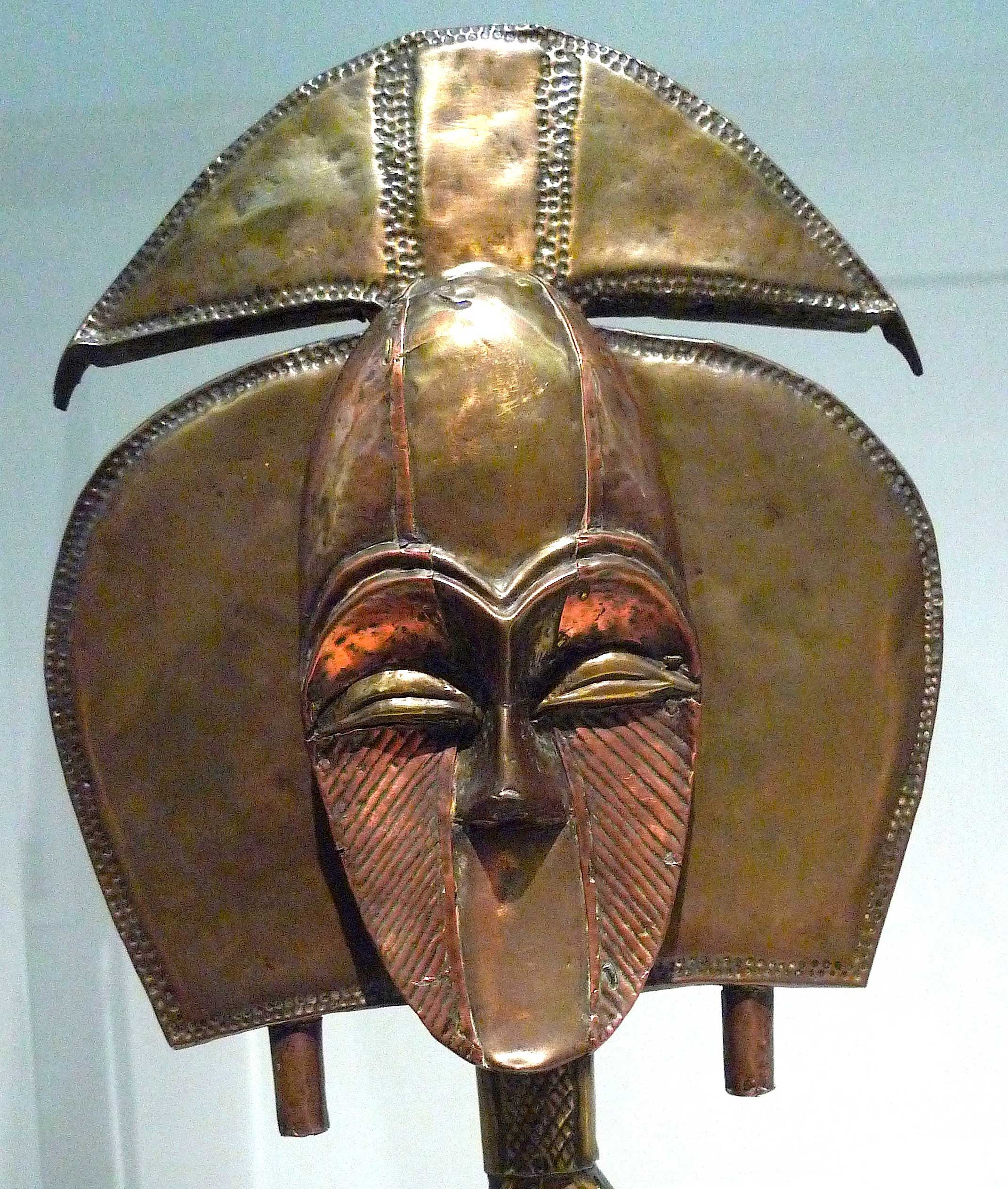
The brass and copper utilized to adorn the wood cores of the guardian figures could only be obtained through trade, so the materials were rare and precious. The metal’s reflective surface evoked sunlight on rivers or the ocean. Since the realm of the supernatural was thought to exist below or beyond these bodies of water, the inherent properties of the metals were themselves associated with the supernatural. The metal surfaces of these figures were continuously burnished to perpetuate their symbolically valuable reflective qualities.
Figure du Gardien Reliquaire (Mbulu Ngulu) fin 19ème – début 20ème siècle (détail). Photographie : Ruben C. Cordova.
Des alliages avec différentes quantités de cuivre ont été utilisés pour créer des traits et des motifs faciaux individuels. Pour une courte vidéo qui comprend une analyse de la fabrication d’un reliquaire Kota, voir la vidéo Smarthistory racontée par Kathryn Wysocki Gunsch et Steven Zucker.
Le métal qui a été obtenu pour façonner ces figures se présentait généralement sous la forme de plaques européennes. Dans un dessin, Cloth montre comment toutes les pièces de métal nécessaires à une petite figure peuvent être fabriquées à partir d’une seule plaque; dans un autre dessin, il montre comment une œuvre plus grande a été fabriquée, y compris chaque clou (TAMK, p. 31, 35).
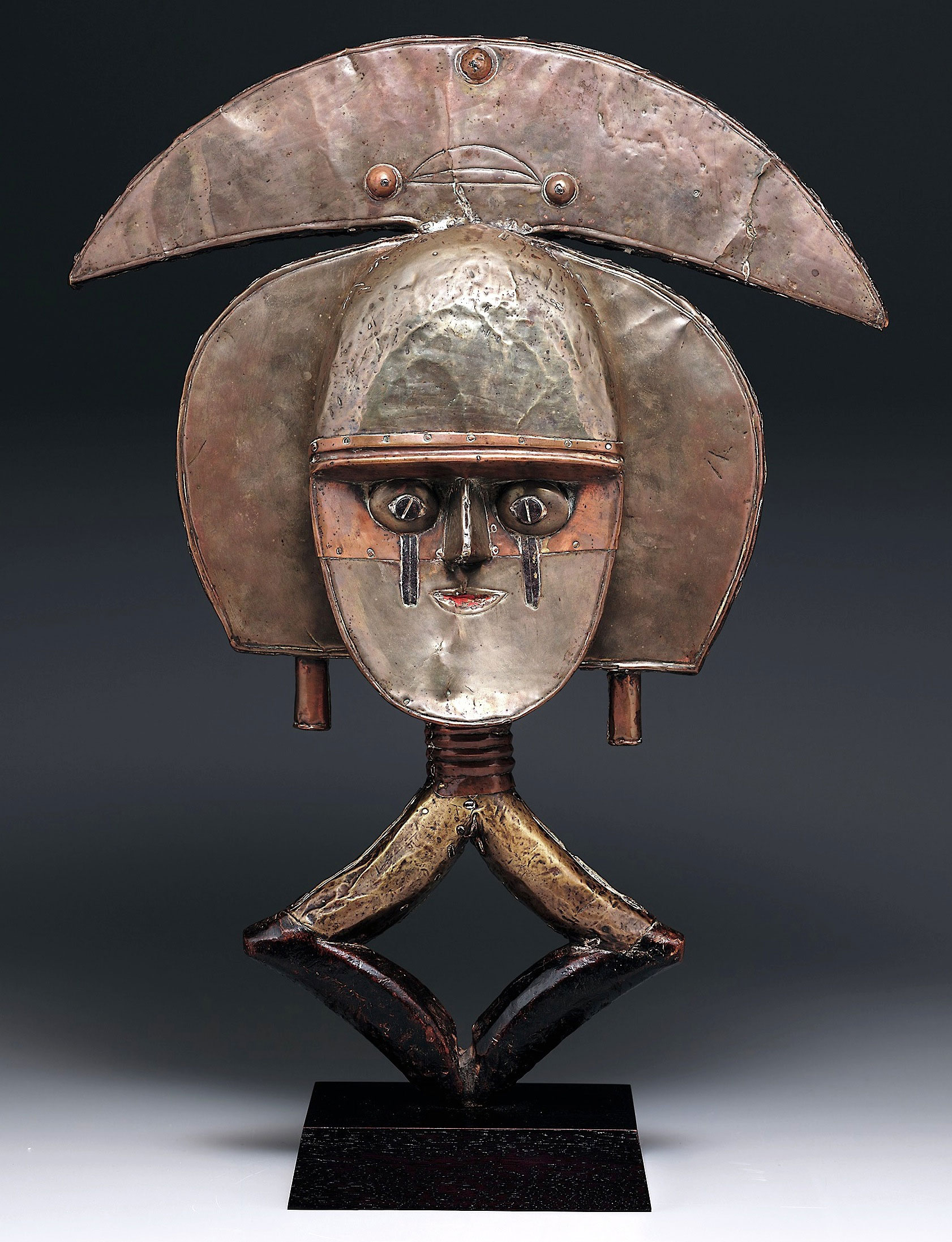
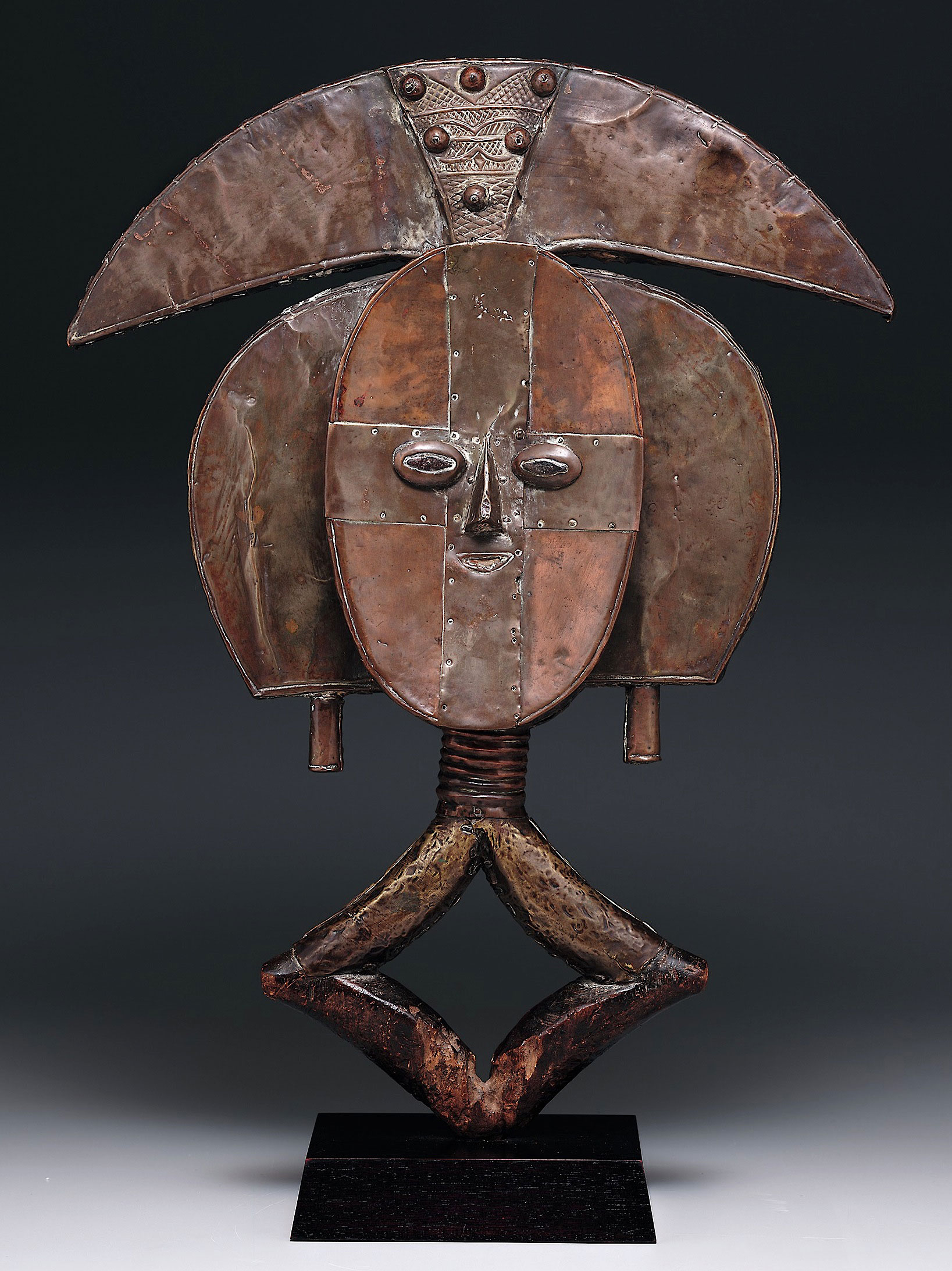
On peut facilement lire les éléments centraux des figures reliquaires de Kota, comme celui illustré ci-dessus. Il a des yeux et un nez (certains exemples ont aussi des bouches). Mais comment interpréter la forme en forme de croissant de lune au sommet, et les rabats sur les côtés, avec les petites formes qui pendent comme des boucles d’oreilles (ou qui s’étendent comme de petits bras dans d’autres figures)?
Cloth a fait un diagramme qui cartographie l’aplatissement d’une sculpture en bois tridimensionnelle dans la forme stylisée d’un reliquaire Kota (TAMK, p. 65). La forme du croissant de lune dérive d’une crête de plumes (vue latéralement) qui descendait au centre de la tête de la sculpture en bois. Il a été doublé et fusionné en une seule forme. Les rabats sur le côté représentent les côtés du visage. Les petits éléments au bas des rabats de chaque côté représentent des oreilles.
Attribué à Semangoy de Zokolunga, Janus Reliquary Guardian Figure (Mbulu Ngulu) (vue de face), fin du 19ème ou début du 20ème siècle, Kota: Obamba; Gabon, laiton, cuivre, fer, bois et fibre, Dallas Museum of Art, The Eugene and Margaret McDermott Art Fund, Inc., 2005.36McD. Photographie : Dallas Museum of Art.
Il s’agit d’une figure reliquaire rare connue sous le nom de figure de Janus car elle a un visage de chaque côté. Seulement environ 50 reliquaires Kota sont jaiformes (avec un visage de chaque côté). Cette œuvre du Dallas Museum of Art est également l’une des œuvres pour lesquelles des créateurs spécifiques ont été postulés.
Attributed to Semangoy of Zokolunga, Janus Reliquary Guardian Figure (Mbulu Ngulu) (rear view), late 19th or early 20th century, Kota: Obamba; Gabon, brass, copper, iron, wood, and fiber, The Dallas Museum of Art, The Eugene and Margaret McDermott Art Fund, Inc., 2005.36McD. Photograph: Dallas Art Museum.
There is still uncertainty about what the two faces stand for. It is often posited that they stand for male and female, with the convex face as male and the concave face as female. Some think the two faces could symbolize future and past, or the living and the dead.
Cloth emphasizes that the only surviving account from the Kota, which was given to the Swedish missionary Efraïm Anderson, makes the male / female identification. Anderson also noted that the janiform reliquaries could eat goat and chicken at the same time and were thus “more powerful.”
The Teke (who are neighbors to the Kota in several regions) have some spirits that are both male and female, and are addressed by separately gendered cults. Cloth notes that the janiform reliquary figures mostly appear in regions in close proximity to the Teke. He posits that the janiform figures are “of a single spirit with two possible faces” that receive offerings of goat and chicken from separate cults. Cloth takes this duality as more evidence that the reliquaries represent spirits rather than ancestral figures.
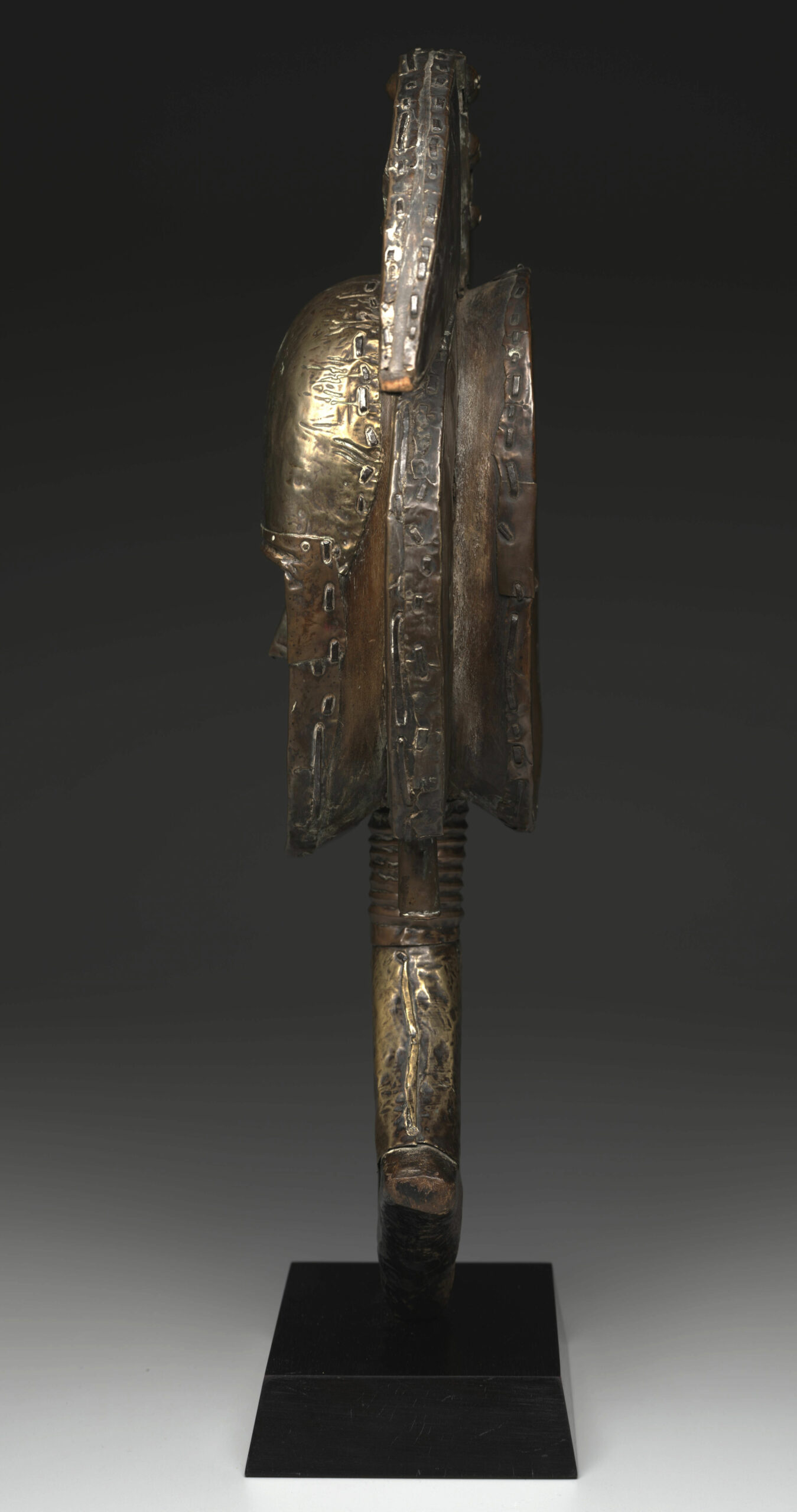
Attributed to Semangoy of Zokolunga, Janus Reliquary Guardian Figure (Mbulu Ngulu) (side view), late 19th or early 20th century, Kota: Obamba; Gabon, brass, copper, iron, wood, and fiber, Dallas Museum of Art, The Eugene and Margaret McDermott Art Fund, Inc., 2005.36McD. Photograph: Dallas Art Museum.
The side view shows just how thin these reliquaries are.
Reliquary Guardian Figure (Mbulu Ngulu), late 19th – early 20th century, Kota: Obamba, Gabon, wood, copper, brass, and iron, The Art Institute of Chicago, Charles H. and Mary F. Worcester Collection Fund, 2007.212. Photograph: Art Institute of Chicago.
This unusual guardian figure has a nose whose bridge continues all the way to the top of its pointy-head. On the reverse, it has a beveled edge that continues from its neck to the tip of its head.
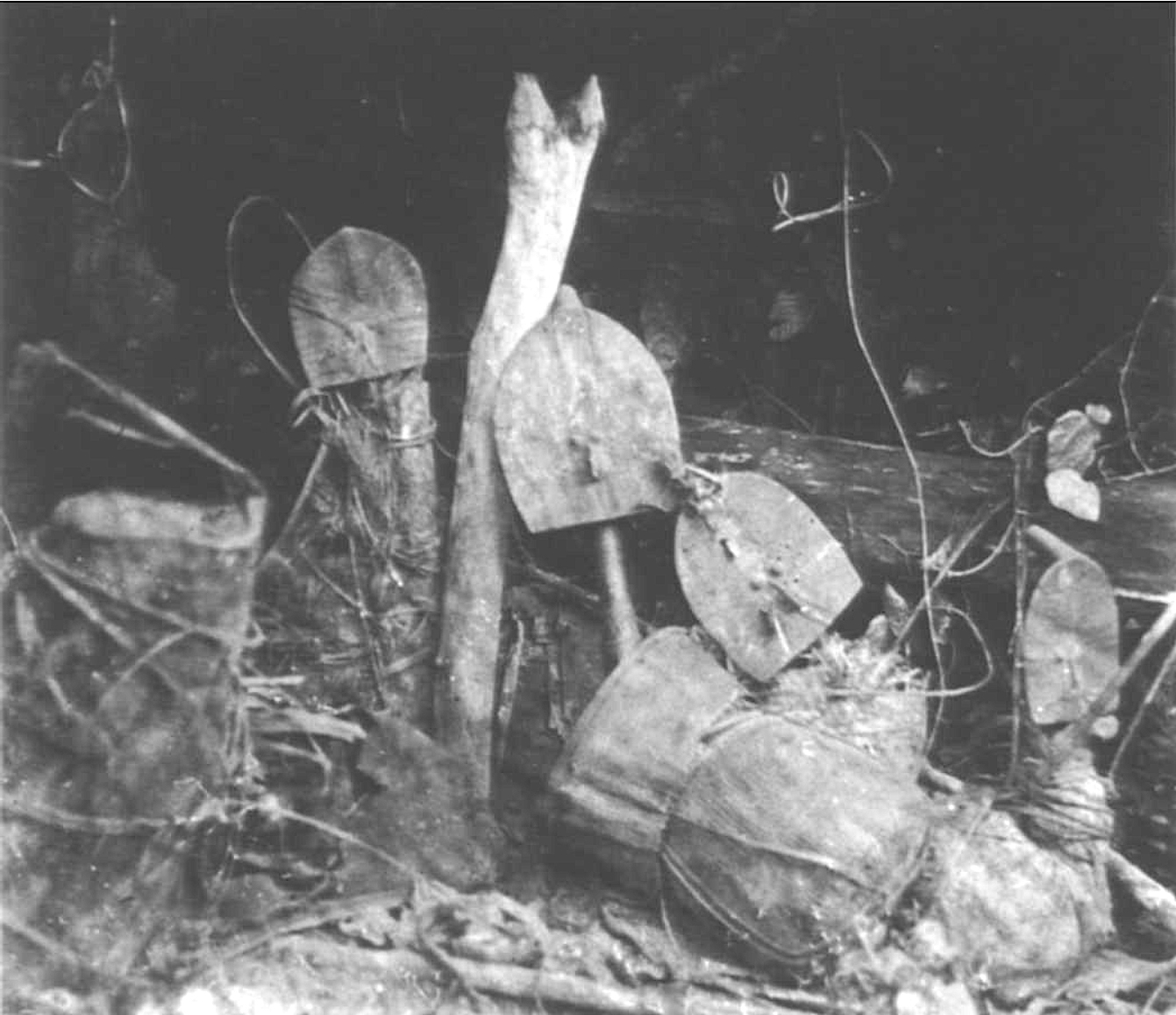
Cache of Mahongwe reliquaries at the French military post of Kemboma Matote, Liboumba River, Ogooué-Ivindo, Gabon, c. 1929-1931. Photograph: Eternal Ancestors catalogue, 2007.
Colonial depredation, occupation, and the imposition of Christianity brought an end to the traditional religious practices of the Kota. The production of Kota reliquary ensembles ceased around the time the above photograph was taken. Untold numbers of these artifacts were abandoned under duress or destroyed, except for those that were carted off to other parts of the world.
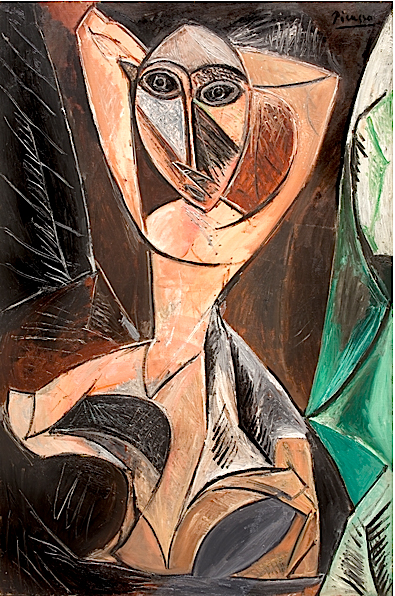
Pablo Picasso (1881 – 1973), “Femme nue aux bras levés” (Nude Woman with Raised Arms), 1907, oil on canvas,
150 × 100 cm, Basil and Elise Goulandris Foundation, Athens. Photograph: Goulandris Foundation.
Now I will consider one example of how a European artist utilized forms from Kota reliquaries. Like many members of the European avant-garde in the early twentieth century, Picasso admired and collected African sculptures. He owned at least two Kota reliquary guardian figures, and they are presumed to have been among his earliest acquisitions of African tribal objects.
Picasso painted Nude Woman with Raised Arms soon after his landmark painting Le Demoiselles d’Avignon (1907). It contains reminiscences of that great painting and the studies that preceded it.
By the 1930s, scholars such as Robert Goldwater and Alfred Barr recognized a connection between Nude Woman with Raised Arms and Kota reliquary figures. Barr, who created the modernist canon as the founding director of the Museum of Modern Art, wrote in Picasso: Forty Years of his Art (1939) that Nude Woman with Raised Arms was more influenced by African sculpture than the figures in the Demoiselles. In the book, Barr called Nude Woman with Raised Arms “the masterpiece of a brief barbaric phase of the Negro period.” It is generally recognized that the upper legs of Nude Woman with Raised Arms are a reminiscence of the upper portion of the diamond-shaped base of Kota reliquary sculptures.
One might make some other connections, including the Picasso painting’s oversized head, its undersized body (like the neck of the Kota figures), the hatching marks that resemble those found on some Kota figures, and the area above the eyebrows in the head (some Kota figures have a separate area above the eyebrows). That area above the eyebrows in the Picasso painting is a little reminiscent of the crescent moon-like shape at the top of many Kota reliquary figures. The upraised arms of the figure in Picasso’s painting echo the flaps on the side of many Kota reliquary heads. The arm on the right side of the painting even seems to be congealing into a flap-like element adjacent to the head.
Picasso was a great synthesizer of forms from cultures that were not part of the Western canon of high art, and many of these influences are evident in this period of his work. These various non-canonical forms were referred to generally as “primitif.” I argued in my dissertation (“Primitivism and Picasso’s Early Cubism,” 1998) that the twisted lower legs of Picasso’s figure were influenced by El Greco, especially his Vision of Saint John (c. 1608-14). Picasso had access to the El Greco painting because it was acquired by his friend Ignacio Zuloaga in 1905.
Picasso’s legs have incredible torsion because one leg is kneeling, while the other leg is rising from a kneeling position. This is analogous to the ambiguously posed legs of the figure in the left foreground of Greco’s Vision of Saint John. El Greco deployed this unusual pose several times. (See my “José Clemente Orozco’s Studies in the Michael Wornick Collection,” 2015, San Jose Museum of Art, footnote 8.)
Picasso’s twisted legs imply dynamism and motion, qualities that are at odds with the figure’s upper body, with its hands-behind-the-head pose. The dynamic legs of Nude Woman with Raised Arms, in conjunction with several preliminary studies that appear to show dance moves, have led scholars to interpret this figure as a dancer. This is evident in the titles they have applied to this painting: Grandé danseuse d’Avignon, Dancer, Danseuse nègre, and Ballerina 2.
Exhibition of African sculpture at the Musée Van Buuren, Brussels, in 2020, with Kota reliquary figures atop a piano. Photograph: mu-inthecity.com
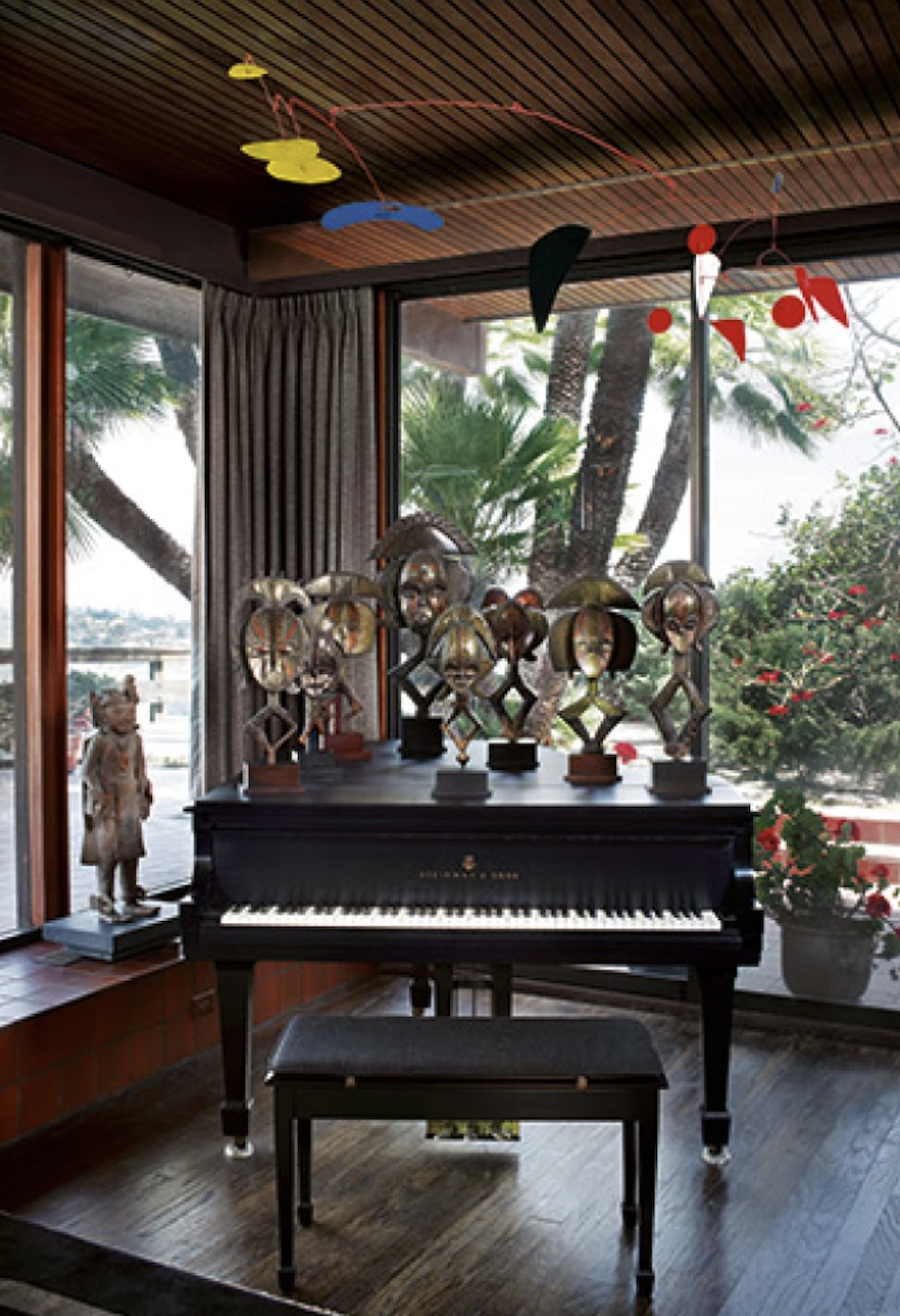
European (and U.S.) audiences have often associated the diamond-shaped base of Kota reliquaries with dancing legs (and with music), whether consciously or unconsciously, beginning with the figure atop the drum in the Trocadéro Heliogravure reproduced above. Picasso himself appears to have made the association between Kota reliquary figures and dance. Moreover, collections of Kota reliquary figures have sometimes been exhibited atop pianos, as in the photographs directly above and below.
Edwin and Cherie Silver’s collection of Kota reliquary figures, as exhibited in their home atop a Steinway piano before they auctioned the works at Sotheby’s in 2017. Photograph: Sotheby’s.
As European colonial powers conquered or dominated African peoples, concerted attempts were made to eradicate traditional religious beliefs. African sculptures were destroyed or taken to Europe, where they served to invigorate early modern artistic traditions.
Critical developments in the reception of African artifacts took place in New York City in the early 1980s. In February of 1982, the Metropolitan Museum of Art opened its much-anticipated Michael C. Rockefeller Wing, which housed the Department of Primitive Art (the department was renamed in 1991).
As reflected in Hilton Kramer’s New York Times review, which was titled “The High Art of Primitivism,” this was taken as a sign that “primitive art” was, at long last, welcomed into the hallowed halls of high civilization:
For with this monumental elevation of the art of primitive cultures to a place of museological parity with the most esteemed masterworks of the ancient and modern worlds, we are entering a new phase not only in the history of taste but in the history of the moral imagination. … the disposition to regard primitive modes of culture and experience as equal in value to our own, and in some respects even superior and more vital – has ceased to be the possession of a minority of cultural visionaries and achieved a new status as part of the mainstream of cultural life.
The exhibition Primitivism in 20th Century Art: Affinity of the Tribal and the Modern opened at the Museum of Modern Art (MoMA) in New York in 1984 before traveling to Detroit and Dallas. It marked a turning point in public perceptions of tribal art. The exhibition effectively showcased the pervasive influence of tribal works on modern art. Many viewers judged the tribal works — which were of extraordinary quality — to be superior to the modern Western works.
MoMA’s large, two-volume catalogue featured many contributions to scholarship. Perhaps more importantly, several problematic assumptions made by the essayists, and particularly by the exhibition’s chief curator, William Rubin, the director of the museum’s Department of Painting and Sculpture, were subjected to powerful critiques by several important scholars. None of these were more withering and sustained than those of Thomas McEvilly, which began in an Artforum review and continued in letters-to-the-editor exchanges with Rubin.
In his review, McEvilly noted:
No attempt is made to recover an emic, or inside, sense of what primitive esthetics really were or are. … by their [Rubin and Kirk Varnedoe] absolute repression of primitive context, meaning, content, and intention … they have treated the primitives as less than human, less than cultural — as shadows of a culture, their selfhood, their Otherness wrung out of them. … In their native contexts these objects were invested with feelings of awe and dread, not of esthetic ennoblement.
In the above passage, McEvilley is criticizing the lack of an approach like that utilized in The Language of Beauty in African Art. McEvilley and others derided Rubin’s curatorial assumptions.
The Center for African Art (now the Africa Center) opened in New York City in September of 1984. It organized many important exhibitions, including Art / Artifact: African Art in Anthropology Collections (1987), which examined African works from indigenous perspectives.
By the early 1980s, artifacts from Africa (and other tribal and court cultures) had taken center stage in the art capital of the U.S. Moreover, this prominence had led to critical reappraisals of long-held prejudices, beliefs, and attitudes pertaining to African cultures and objects.
The following section features short discussions of particular objects in the Language of Beauty exhibition.
Beauty and Ugliness in Sculptures and Masks
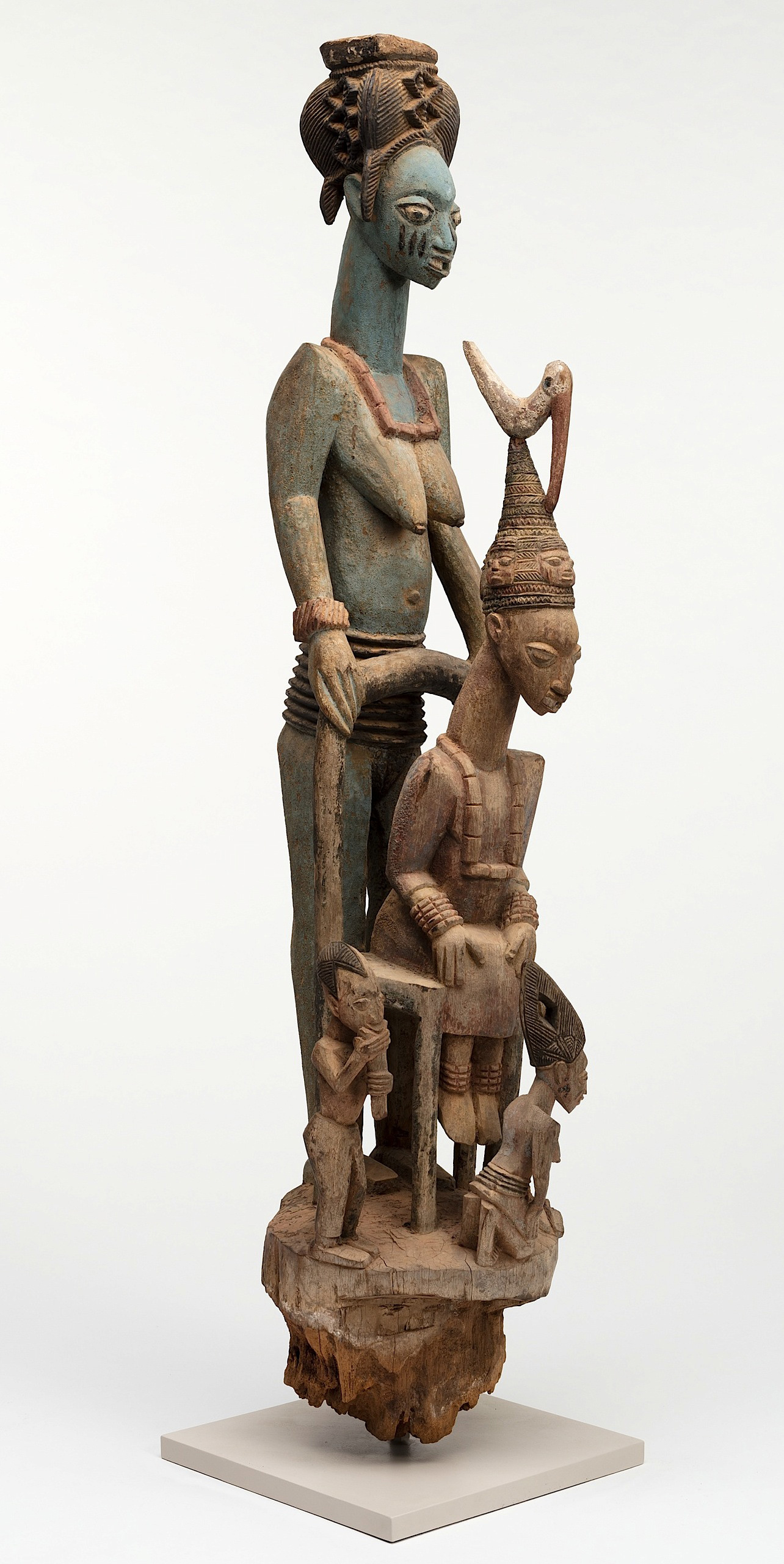
Olowe of Ise (c. 1869–1938), Veranda Post (Opo Ogoga), 1910–14, Yoruba: Ekiti; Ikere, Nigeria Wood and pigment, The Art Institute of Chicago, Major Acquisitions Centennial Fund, 1984.550. Photograph: Art Institute of Chicago.
This is one of four posts that Olowe of Ise made for the palace of the king (ogoga) of Ikere.
Photograph by William Buller Fagg of the palace of the King of Ikere, 1959, with three veranda posts by Olowe of Ise (c. 1869–1938). Photograph: from LOB exhibition didactic.
Three of the posts are visible in the above photograph. The post in the exhibition is in the center. It is missing one of the three subsidiary sculptures visible on the base in the photograph.
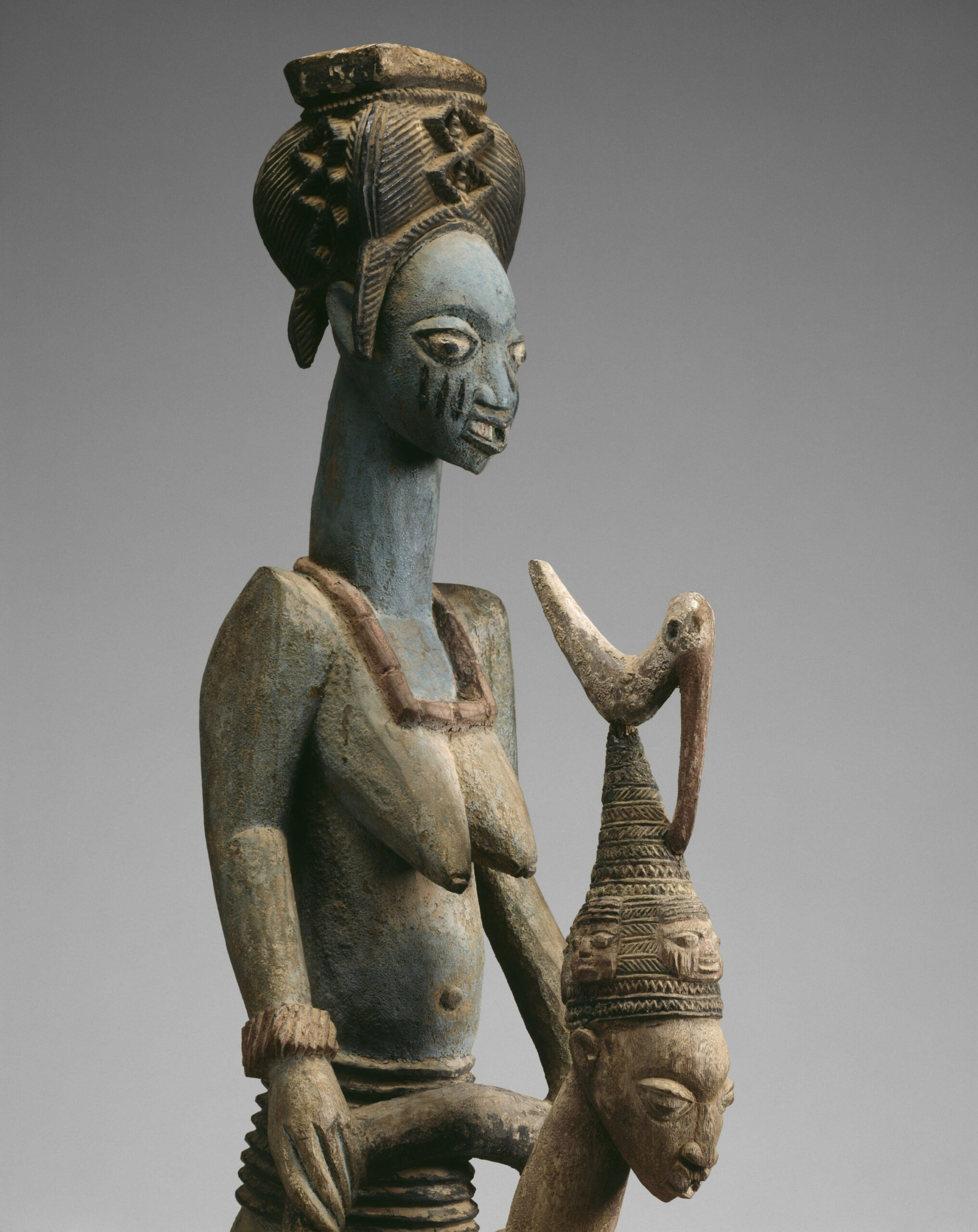
Olowe of Ise (c. 1869–1938), Veranda Post (Opo Ogoga), 1910–14 (detail). Photograph: Art Institute of Chicago.
The diminutive king’s chief wife towers over him (and holds up a beam), while a tiny, subsidiary wife kneels in supplication at his feet. The other small figure represents the trickster god Eshu, who is likewise depicted as a lesser figure than the royal couple.
The queen, who holds the king’s chair, crowned him at the coronation ceremony. The king’s crown — which is significantly larger than the visible portion of his head — symbolizes the spiritual power of his office. The bird alludes to the initial creation of habitable land (accomplished with the assistance of a mythical bird). It is also an archetypal female symbol.
The queen’s bulging eyes convey the belief that she has attained supernatural knowledge. Scale and symbols convey important information to Yoruba viewers.
SOURCE : GLASSTIRE
Soutenez et faites un don Vous pouvez montrer votre appréciation pour RadioTamTam et soutenir le développement futur en faisant un don ou en achetant les produits partenaire d’affiliation. Merci! Ensemble pour façonner une radio dynamique. Faites un don maintenant Payez ce que vous pouvez vous permettre. Ensemble pour façonner une radio dynamique. Faites un don maintenant Cliquez sur le bouton ci-dessous MAINTENANT pour commencer et je vous souhaite la bienvenue de l’autre côté. Payez ce que vous pouvez vous permettre. Ensemble pour façonner une radio dynamique. Faites un don maintenant Cliquez sur le bouton ci-dessous MAINTENANT pour commencer et je vous souhaite la bienvenue de l’autre côté.
Tous les produits présentés dans cette histoire sont sélectionnés indépendamment par nos éditeurs. Toutefois, lorsque vous achetez quelque chose par le biais de nos liens de vente au détail, nous pouvons gagner une commission d’affiliation pour financer les charges de la station radio, vous pouvez nous soutenir en faisant vos achats.